
How to Insulate a Cold Wall from the Inside
By Lee Morley, Leeds Renderers · Updated 12 October 2026
Quick answer
A cold internal wall is best fixed by adding a thermal layer so the wall surface stays warm enough that condensation can't form. The two main options are internal wall insulation (insulated boards fixed to the wall, losing a little room space) or a thin SprayCork internal coating that raises surface temperature, stops condensation and mould, and loses almost no space. The right choice depends on how cold the wall is and whether the room can spare the space.
Key takeaways
- Cold walls cause condensation and black mould, warming the surface stops it
- SprayCork internal coating: thin, breathable, no lost floor space
- Insulated plasterboard: bigger thermal gain, loses ~50 to 100mm per wall
- Solid-wall Victorian and 1930s homes in West Yorkshire benefit most
- Fix the cause, not just the mould, paint-over solutions fail
- External wall insulation is the best option where the outside can be done
Instant price estimator
Step 1 of 6What type of property?
At a glance
| Insulated plasterboard | SprayCork internal coating | |
|---|---|---|
| Thickness lost | ~50 to 100mm per wall | Only a few millimetres |
| Thermal improvement | Large | Moderate, lifts surface temperature |
| Condensation & mould | Solved if detailed well | Solved, surface stays warm |
| Disruption | Higher, skirting, sockets moved | Low, spray applied, fast |
| Breathability | Needs correct specification | Naturally breathable |
Why is your wall cold and damp?
Solid-wall homes, common across Leeds, Bradford, Wakefield and the West Yorkshire towns, have no cavity to insulate. Heat escapes straight through the brick or stone, the inside face of the wall stays cold, and warm moist air from cooking, showers and drying clothes condenses on it. That moisture is what feeds black mould, usually in corners, behind furniture and around windows.
Option 1: SprayCork internal anti-condensation coating
SprayCork is sprayed directly onto the prepared internal wall in thin coats. The natural cork particles raise the surface temperature of the wall, so condensation can't form and mould has nothing to live on. It's breathable, flexible, takes a decorative finish, and because it's only a few millimetres thick you lose no meaningful floor space, ideal for bedrooms, bay walls, gable ends and rooms where skirting, sockets and fitted furniture make boards impractical.
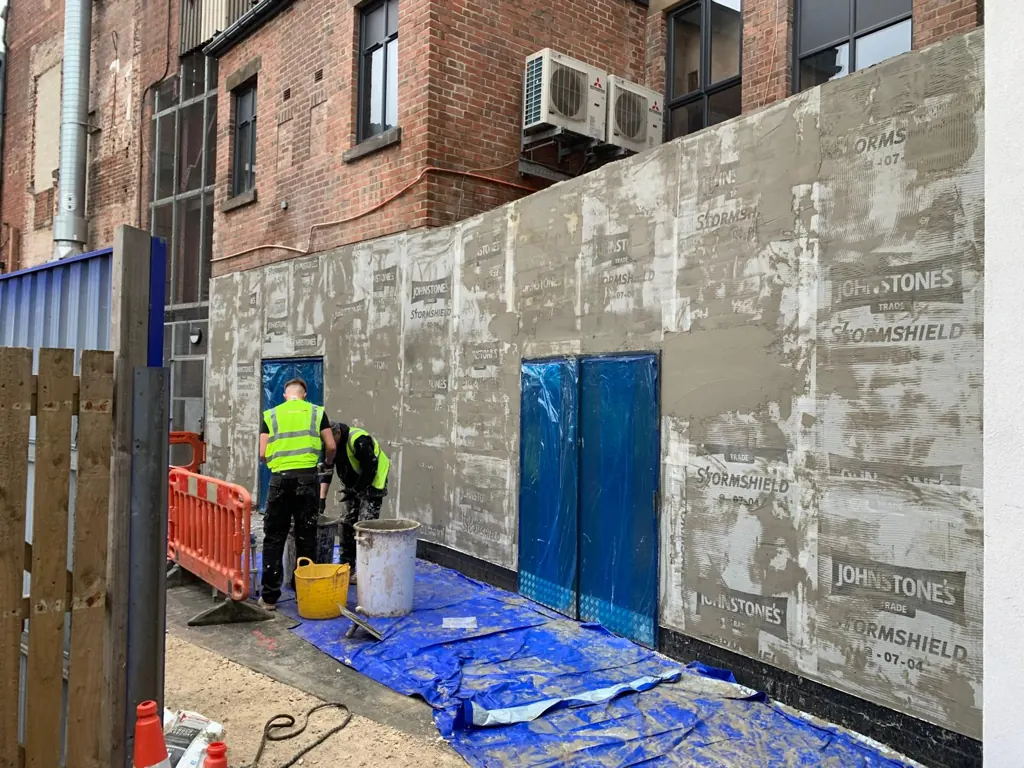
Exterior mesh and basecoat work from our portfolio, illustrating the external wall approach discussed above. This is not an internal insulation or SprayCork installation.
Option 2: Internal wall insulation boards
Where a room can spare the space, insulated plasterboard fixed to the wall gives a bigger thermal upgrade and can transform a cold north-facing room. The trade-off is disruption: skirting, coving, sockets and window reveals all need extending, and the detailing must be right or cold bridges remain at the edges.
Option 3: Fix it from the outside instead
If the exterior is due for work anyway, external wall insulation or an external SprayCork coating warms the whole wall structure, keeps the room sizes intact and transforms the look of the house at the same time. We'll tell you honestly on survey which side of the wall is the smarter place to spend the money.
What not to do
Common mistakes we get called in to put right:
- Painting over mould with stain-block, it grows back through
- Sealing the wall with non-breathable coatings, traps moisture inside
- Insulating over a damp wall without finding the source first
- Relying on a dehumidifier alone, it manages symptoms, not the cold wall
How we approach it
On a free survey we take surface temperature and moisture readings, check for penetrating damp or bridging, and then recommend the thinnest, most cost-effective fix, whether that's an internal SprayCork coating, insulated boards, or doing the work from outside instead.
Want to know if your walls are suitable?
We tap-test every elevation on a free survey and give a fixed written price.
Frequently asked questions
Can you insulate a cold wall without losing room space?
Yes. A SprayCork internal coating is only a few millimetres thick and raises the wall's surface temperature enough to stop condensation and mould, with no meaningful loss of space.
Does internal insulation stop black mould?
Yes, if it warms the wall surface above the dew point. Both SprayCork coatings and properly detailed insulated boards achieve this, painting over mould does not.
Is SprayCork suitable for bedrooms and living rooms?
Yes. It's water-based, low-odour, breathable and takes a decorative finish, making it suitable for any lived-in room.
My house is solid stone, can you still help?
Yes. Solid stone and brick walls are exactly what these systems are designed for, and breathability matters even more on older masonry.
Is it cheaper to insulate from inside or outside?
Internal coatings are usually the lower-cost route for one or two problem walls; external insulation costs more but upgrades the whole house and its appearance. We price both on survey.
Related guide: Can You Render Over Pebbledash or Brickwork?Can You Render Over Existing Render?How Much Does Rendering Cost in Leeds & West Yorkshire?
Up to 25-year manufacturer guarantees
Because we're approved and certified by the system manufacturers, your finish is backed by them, not just by us.
“Our pebbledash semi looks like a new build. Tidy team, finished on time and the cork has made the front bedroom noticeably warmer.”
“Clear quote naming the exact Baumit system, no surprises. Scaffold up Monday, down the following Wednesday.”
“They didn't need to hack off the old dash which saved us thousands. Brilliant finish.”
“Black mould in the back bedroom was a yearly battle. CorkSol inside has fixed it.”
Get a free survey and fixed price
Free survey, written quote naming the exact system, and no pressure. Most quotes within 48 hours.
Approved SprayCork, CorkSol, VPI, Baumit, K Rend & Weber applicators